
Meeting Minutes
More on public records

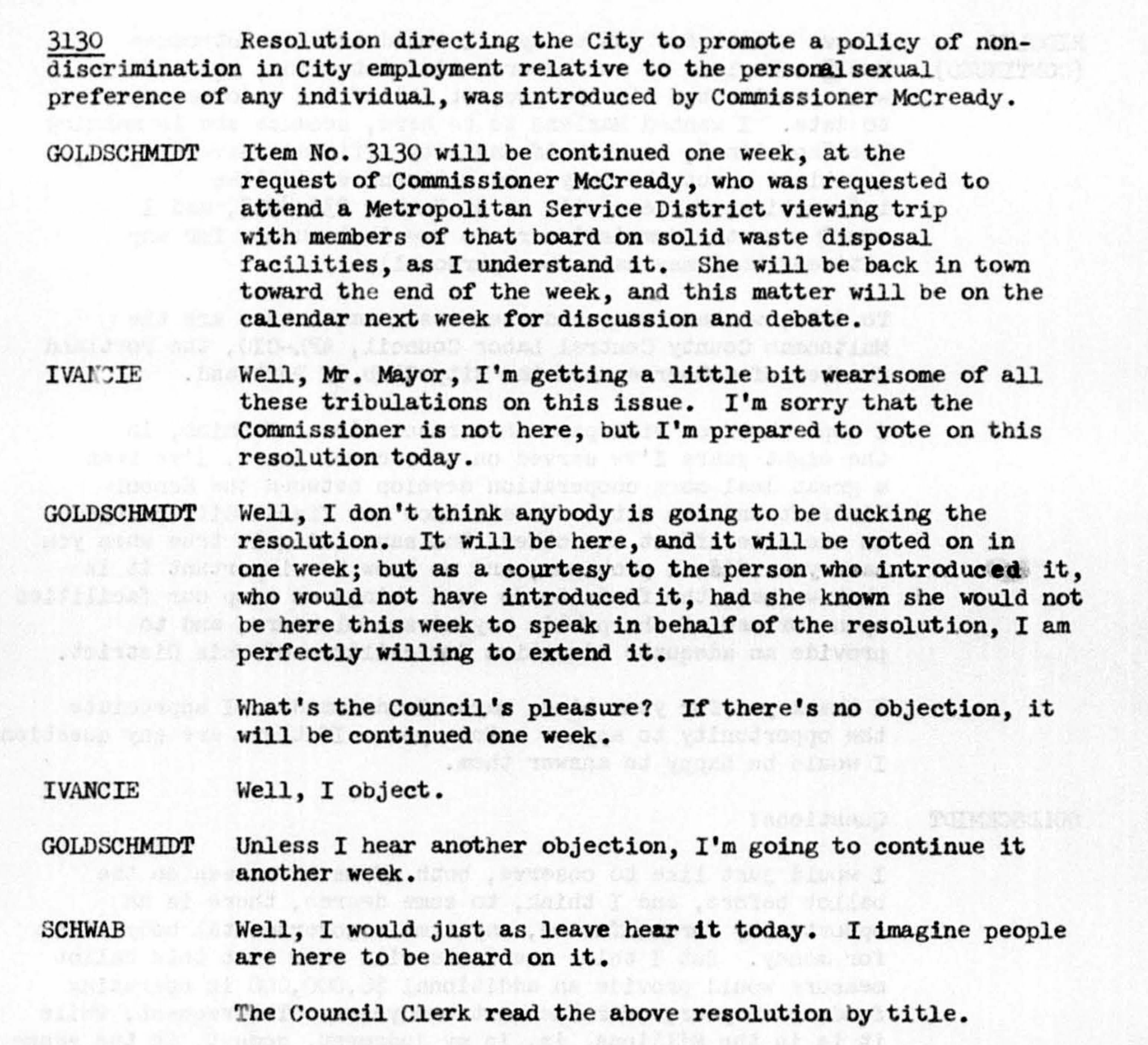
I know it is a weird thing to say, but I love meeting minutes, especially government meeting minutes. The City of Portland Council meetings have had verbatim minutes for decades, except from 1985 to 2000 when they
went to summary minutes. I love meeting minutes because that is where the why lives.
Researchers often asked why something was done, why council made a change to a policy, or why it was decided to stop a program. Most people don’t write down their why, we just make the change and move on. Often we think we are improving the process with a bright new idea, which certainly might be the case but not always in my experience. We address the how, the when and the what in official documents because we know the why. And we believe we will always remember why we decided to do what we do. I find that we do not remember why most of the time and we certainly don’t pass along the why for the next person. Hence the researchers, especially lawyers, asking why.
Meeting minutes capture the discussion about changes or the status quo. Minutes document how people talked and felt about the issues. When members of the public testify at council, those perspectives are documented along with the elected officials and city employees. Each person’s voice becomes part of the official record, a record that is required by law to be maintained forever.
Of course now there are video and audio recordings that are made available online, which are a wonderful addition, but I am still partial to meeting minutes. They are another form of our written collective history. I have found testimony about all kinds of subjects that are now part of the official record of the city.
When helping a researcher find information about Black owned clubs in the 1940s in Portland, I turned to liquor licenses as those had to go through City council at the time. We found William McClendon and Club Savoy in 1949.
Communication from Wm. H. McClendon requesting that he be granted a liquor license to operate Club Savoy at 1500 N Williams Avenue and that the customary 90 day waiting period be waived, was presented and read by title.


Sounds pretty straight forward and not worth note. However, the letter McClendon wrote and submitted was read into the council record. What is of note is that McClendon was also the publisher of the Portland Observer, a newspaper focusing on issues facing African Americans in Portland before and during WWII. He was a journalist, activist and jazz musician. His letter spoke to the experience of African Americans in Portland in 1949. McClendon’s words and perspective might have been lost to a wider audience if not part of Council minutes.
This is a Portland specific example, however I believe it can be translated to any other type of public record minutes. My goal is to help folks realize the value and varied nature of public records. There is so much to learn if we just look for it.
Totally agree. To hear the voice of an individual through their own words - so much more illuminating!
Great perspective. I hear your voice in everything you do. Keep at it, you have a purpose.